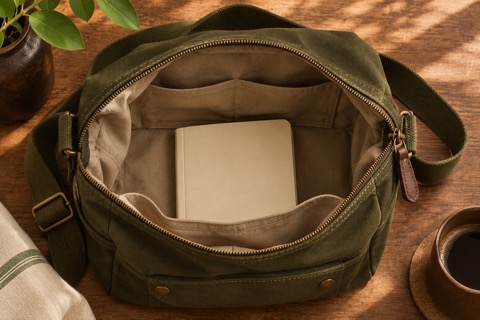
Measure the opening first
Choose an object you plan to carry, such as a rigid notebook or lunch box. Measure it at its widest points, including the thickness and any protruding spine or handle. Then find the opening length between zipper stops or between the points where the sides are stitched together. A bag can look wide from corner to corner even when the finished opening is several centimeters shorter.
Check the shape of the opening while the bag rests naturally. A curved zipper track can leave a useful central opening and tighter space near the ends. If the object has hard corners, think about the angle needed to get it through. A stiff notebook must rotate through the available clearance. A soft pouch has more flexibility, so its success tells you little about the same opening for a rigid item.
Locate the usable floor
Look at the lining and the base with the bag fully open. A padded sleeve, zipped divider or rounded corners can reduce the space available even when the shell appears generous. Find the narrowest width where the object will sit. If the closure slopes down toward one side, use the lower height in that area rather than the tallest outside measurement.
When measuring from photos, check whether a tape is flush with the base or held above it. A tape stretched across the top gives useful information for loading and tells you little about the floor. If no interior measurement is available, save the exterior dimensions with that label and ask which section the object is expected to occupy.