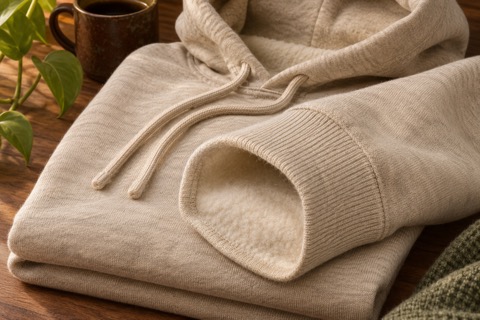
Find the inside face
An outside photo shows the body color and surface finish. Look for a second view with the sweatshirt turned back near the hem or cuff, where you can inspect the reverse side. Closed loops forming tidy rows suggest an unbrushed knit surface. A soft, even fuzz suggests a raised or brushed surface. Side lighting can make either texture look deeper, so compare a close view and a wider one when both are available.
Name what you see in plain terms and keep fiber content in a separate field. A dense-looking close-up offers evidence about the visible surface. A legible garment label or documented composition addresses what the fabric contains. Keep those observations independent because the interior texture alone cannot tell you how much cotton or polyester is present.
Compare bulk at a junction
Use a folded cuff or hem seam to see how the cloth stacks when several layers meet. That is where pocket lining, ribbing and body fabric can create more bulk than a smooth front panel suggests. If you regularly wear a tight coat over a hoodie, compare those stacked areas with a hoodie you already layer comfortably. The cuff opening in a flat photo records only the relaxed state, so compare measurements under the same conditions.
Ask for the reverse-side photo near a seam with a steady light source if all you have is a distant picture. A familiar detail such as the width of a ribbed cuff gives your eye a consistent comparison point. If the image is too soft to resolve loops or fibers, leave the finish field open.